
Last Breath: A Gripping Sea Survival Thriller That Dives Deep
Best4Boats Rating: 4.5/5 Burgees
SPOILER WARNING!!!

Last Breath is a tight, thrilling film about the true story of a trio of North Sea deep sea saturation divers and their supporting ship’s crew. A routine gas pipeline job goes sideways with a diver stranded at 300’ deep, alone in the pitch black without air. Can the bridge crew and his fellow divers battle 20’ seas and the deep to retrieve him in time? Or will 29 minutes without oxygen render the lost diver Chris Lemons dead or a vegetable?
Directed by Alex Parkinson who also directed the 2019 documentary of the same name about this maritime incident, Last Breath makes the cut as a Best4Boats recommends.
Technical forward and I love it
One element of the film I greatly appreciated was that it didn’t shy away from the technical aspects of maritime—rather leaned in hard. Much like the classic Apollo 13 about that troubled moon mission’s return to Earth, Last Breath’s major plot points and drivers of suspense are operations and engineering challenges. Heroism in this world manifests as cool heads making the right call. Much like true mountaineering thriller Into Thin Air by Jon Krakauer, one can follow the chain of decisions and events that led the characters into, and ultimately out of, danger.
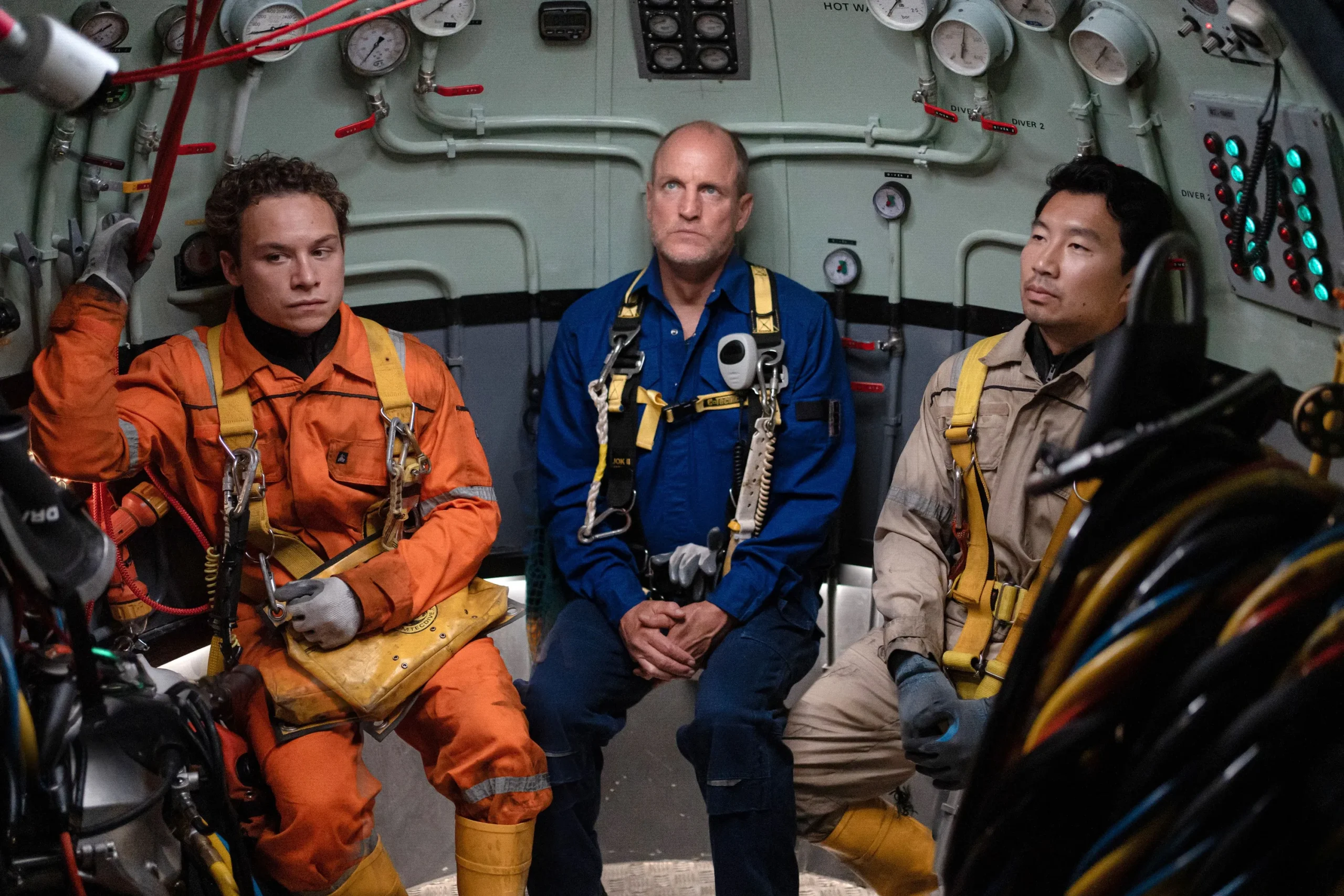
For example, when getting onto the dive site, the vessel captained by Andre Jenson (played by Cliff Curtis) notes that the seas are 20’. “It’s borderline, but we are in the North Sea” replies dive supervisor Craig (played by Mark Bonnar). The go decision is made and the dynamic position system (DPS) is deployed. A dive bell with three divers—the main characters Duncan Allock, Dave Yuasa, and Chris Lemons; played by Woody Harrelson, Simu Liu, and Finn Cole respectively—is deployed to depth to work on a submerged gas pipeline manifold.
DPS as a technology is industry standard across much of maritime operations today. The technology allows working vessels to maintain their exact coordinates thanks to a combination of global positioning data, sophisticated onboard software, and a series of powerful thrusters. This capability is critical for saturated dive missions as the diving bell is connect to the ship and cannot be dragged about. I don’t have any experience on a commercial saturation dive vessel nor its DPS systems, but the movie seemed very realistically depicted. The bridge, made up of the captain, first mate, a DPO (dynamic position officer), ROV pilot, and dive supervisor, felt authentic.
In fact, that darn DPS becomes the main driver of the plot not unlike the oxygen tank explosion aboard the aforementioned Apollo 13 mission. The DPS system completely fails with no explanation, rendering the ship functionally dead in 20’ seas. The vessel immediately drifts off site, dragging the attached dive bell and two working divers attached via umbilical lines. One diver, Yuasa, manages to fairlead his umbilical line over a manifold superstructure to be dragged along in relatively safely. But Lemon’s line is snagged on the manifold—snapping and leaving him at the bottom with five minutes of emergency oxygen that he burns through in good order.
Believe it or not, all this action is just the set-up of the film. The rest of the movie is a race against time to get the DPS system online and back to station to retrieve Lemons. Meanwhile down below, the two surviving divers in the bell also plot their best course of action, their friend’s life depending on how they perform with whatever opportunity the ship’s crew can give them.
As a person who is into marine stuff, there is a lot of real-world equipment brought to bear that we don’t often see on film. For me, it’s like a comic book fan seeing a new favorite superhero make a surprise appearance in a Marvel movie. A plucky ROV makes a recovery attempt, the pilot sweating as the high-powered claw veers close to the diver’s vitals. The bridge crew take to the thruster controls, standard operating procedures be dammed, to manually fight the 20’ seas, a bit like how Neil Armstrong turned off the computer to land Eagle on the moon. The exasperated DPO throws himself into the below deck wiring, multimeter in-hand, trying to bypass the system for a reset. All the while, the relentless timer makes appearances to show us how long Chris Lemon has been oxygen deprived and ramp up the tension.
What I love about all this is that the real-world techy details adds to the storytelling in such a fast paced, engaging way. I don’t think non-wonky types will be turned off.
The Human Element – Classic in a good way
Naturally, there is an earnest sappy romance thread between the threatened diver and his Scottish fiancé Morag back on land. The two other divers have their subtle character arcs too. The elder diver Allock faces forced retirement from the higher ups, starting the story passively accepting his fate only to grow in his resolve to stay in the dive life post rescue—“I’m not ready for the scrapheap yet”. Woody Harrelson imbues Allock with a sort of grandfatherly charm.
The other diver Yuasa begins the tale cold and standoffish, reminding rookie Lemons to stay focused when he sees a picture of his fiancé above his coworker’s bunk. After the life and death events resolve, he reveals he’s been carrying a picture of his two daughters the whole time. Has he learned that our bonds with loved ones are a strength, not a weakness? These little moments make these characters pop more than I’ve seen mainstream critics give credit. It’s a light touch, but Last Breath makes the most of these little moments.
And yes, I like the earnest sappy romance. It’s not overdone and honestly, many movies are so nihilistic and anti-romantic these days that I found it refreshing. Regardless as to whatever is edgy in Hollywood, men and women falling in love, caring about one another, striving through great things to be together, start families, pay the bills, and all that feelgood stuff is a timeless element to storytelling for a reason. And guess what? Audiences tend to like those themes in their movies. Real world home footage of Lemons and Morag make appearances. Haters have their own issues to work through. The movie has a PG-13 rating so it’s pretty approachable for families.
Final Thoughts: Success in the Flopbuster Era
I left the theater feeling refreshed. I’ve all but lost hope that we as a civilization can even make great, tight, true story at-sea thrillers anymore. The Perfect Storm was made 25 years ago and was a smash hit. You’d think we’d get a mainstream The Perfect Storm or Last Breath title every other year or so. Why not center these exciting stories of fellow humans going through trials at sea to do the important stuff—like filling the grocery store aisle or keeping the pipelines working for our home heating? Maybe most people don a Starbucks apron or an office tie for work, but there’s some shared empathy built into these stories. Score one for the little people, especially those that make a living on the water.
Let me make a less ideological appeal to the investors. With a modest budget of around $24 million and an impressive box office opening weekend of about $8 million, Last Breath reminds me of how the $15 million budget Godzilla Minus One was the sleeper hit of 2023—ultimately grossing a >$110 million box office. 2023 was dubbed “year of the flopbuster” and the state of go-for-broke >$100 million budgeted, whacky messes totally eating it and being openly laughed at by most normal people only worsened in 2024. Maybe it’s time to touch grass, or the seafloor, you moguls. Throw $15 to $30 million at a few tight 90- or 120-minute, well written, true story at-sea thrillers every once in a while. Maybe you’ll make some profits and earn Bonafide, off-the-street fans again. When all is said and done, maybe movies like Last Breath with get the last laugh.
I doubt this movie will make as much as Godzilla Minus One, but as a crowd pleaser I predict Last Breathwill punch way above its weight class. For those interested in the marine world like us at Best4Boats, Last Breath is a must watch.

